Burger King’s Whopper Rings ad: when silence does the selling
- Nov 20, 2025
- 4 min read
Burger King France is promoting a limited edition Whopper Rings burger with a quiet, two-minute film that lets the sound of eating do almost all the work.
Instead of the usual fast cuts and loud tracks, the spot sits on a single, steady shot of a diner slowly unwrapping and eating his Whopper. There is no voiceover. No jingle. No punchline copy screaming at the end. Just ambient noise, chewing, a little breathing, and then a late reveal of the new build.
For a brand that recently became famous again for the hyper catchy “Whopper Whopper” jingle, this feels like the exact opposite energy, which is partly why it stands out.
What actually happens in the film
The idea is straightforward, but the craft is tight.
The ad is a two-minute film, shot in one uninterrupted take, framed closely on the lower half of a man’s face as he opens his Whopper and starts eating.
There is no music bed. No supered offers. No scene changes. The only things you really notice are the tiny sounds of paper, bun, lettuce and bite.
Toward the end, when the burger is almost gone, the man finally speaks in French, murmuring to himself about how good it is, how he should have ordered two, and describing what makes this version different.
That is when the product twist lands.
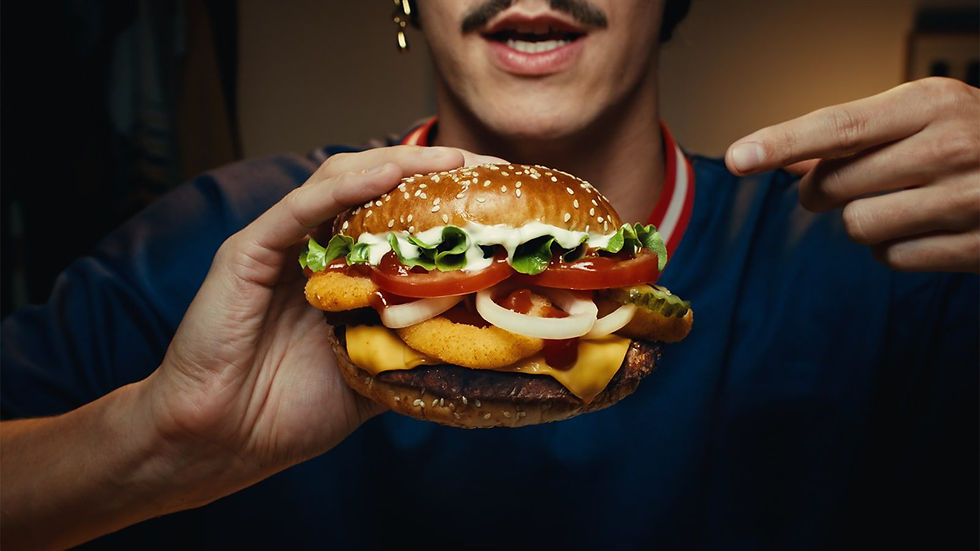
The film reveals that this is not a regular Whopper. It is Whopper Rings - a limited edition variant that adds three crispy onion rings and two slices of cheddar to the classic stack, sold in Burger King France for a short time.
The campaign, created by Buzzman and directed by Lucie Bourdeu, runs in two-minute, sixty-second and thirty-second cuts on TV and in cinemas across France, supported by an in-restaurant launch of the product.
Why the silence feels so loud
Silence is not a gimmick here. It solves a few problems at once.
It cuts through a very noisy category
Fast food advertising is usually one of the loudest things in a break. Big tracks, fast edits, lots of price shouts. Dropping all of that in favour of a held shot and near silence creates instant contrast. In a scroll of sensory overload, the quiet film is the thing your brain notices.
It taps into ASMR and mukbang behaviour
Online, millions of people already watch eating content purely for the crunch and rustle of real sound. This film borrows that dynamic without ever labelling itself as ASMR. The camera feels observational, almost like you are accidentally watching someone enjoy their burger in private. That intimacy is what gives the spot its slightly awkward, hard-to-ignore charm.

It puts total pressure on the product and performance
When you remove music, jokes and graphics, the only thing left to sell is the food and the emotion on the person’s face. The Whopper has always been Burger King’s hero, and the new onion ring and cheddar build gives just enough “newness” for the film to land as a proper product story, not just a mood piece.
The choice to keep the spoken line right till the end is also smart. You sit in the silence long enough that when he finally says, “I should have ordered two,” it feels like a natural thought, not a scripted tagline.
How it fits Burger King’s wider creative pattern
This is not the first time Burger King has played with restraint or discomfort to make the Whopper feel “real”.
The Moldy Whopper campaign showed the burger decomposing over 30 days to dramatise the removal of artificial preservatives.
In Latin America, the Flaming Grill Radio campaign turned silent FM frequencies into the sound of meat sizzling, using radio static as a reminder of flame grilling.
In Finland, the brand experimented with a completely silent drive-thru experience years ago, framing quiet as a benefit rather than an absence.
The Whopper Rings spot sits neatly alongside those. It is another example of Burger King being willing to make viewers slightly uncomfortable if that helps land a simple product truth: there is something deeply satisfying about this burger, and we trust that feeling enough to just sit with it.
It also balances out the other side of the brand, where the “You Rule” and “Whopper Whopper” jingles have turned into full-blown internet earworms. By pushing in the opposite sonic direction in France, Burger King shows it can modulate its volume by market and by message.
Takeaways for marketers
Even as a short campaign overview, there are a few useful cues to steal.
1. Restraint can be more memorable than one more layer of cleverness
Stripping away music, supers, and fast edits is not laziness; it is a bet that one core experience is enough. Here, that experience is “I just need a quiet minute alone with this burger.” If you have a moment or truth that strong, sometimes the best thing you can do for it is remove everything that gets in the way.
2. Let your product carry the creative idea
Whopper Rings is not an extreme innovation. It is a familiar burger base with onion rings and cheddar layered in. The campaign proves that you do not always need a radical product to justify a brave piece of storytelling. You need a clear product angle, and then the courage to dramatise it in a focused way.
3. Use sound design as a strategic lever
Sound is usually treated as post-production decoration. Here, it is the concept. The small crackles and crunches are what make the film sticky, and they carry into cinema and TV environments where people are often half-watching. Thinking about how your brand sounds, not just how it looks, gives you an extra lever in a cluttered media mix.
For Burger King France, the Whopper Rings campaign is a reminder that you do not always need a bigger script or a louder track to say something new. Sometimes, you just need a good product, a steady camera, and the confidence to let a single crunch do the talking.


Comments